
What Waiting One More Season Actually Costs
Here's the short version to settle this: a sticky, swollen, or slightly rusted garage door doesn't fix itself. It gets worse, and it gets worse faster here than it would somewhere dry. A small rust spot on a hinge or track today turns into a seized roller or a cracked panel seam by next summer. A door that drags a little in humid weather now can jump its track entirely once a panel swells unevenly. The fix now might be a $150–$300 tune-up or a single panel repair. The fix later is often a full panel replacement, a new opener because the old one burned out straining against a stuck door, or in the worst case a full door replacement. Ignoring it doesn't save money, it just moves the bill to a bigger number and a worse time.
What's Actually Happening to the Door
Garage doors in this part of Florida deal with two separate problems that get blamed on each other, which is probably part of your argument.
Rust
Steel doors, hinges, tracks, and springs are coated to resist corrosion, but that coating wears thin at edges, screw holes, and weld points. Add in humid air that barely drops overnight, salt carried inland from the coast, and standing moisture after afternoon storms, and bare metal starts oxidizing. Rust shows up first as small orange freckles near the bottom panel, along hinge pins, or on the torsion spring itself. Left alone, it pits the metal, which weakens springs (a real safety issue since they're under heavy tension) and makes hinges grind instead of pivot smoothly.
Swelling
This one hits wood and composite doors, and even steel doors with wood-look overlays or wood trim. Wood absorbs moisture from humid air and from rain that blows in under the eaves during a storm. The wood expands, which is why a door that closed fine in April suddenly binds against the frame in August. When the weather dries out, the wood shrinks back, but not always evenly, so you get warping, gaps, or a door that never quite seats the same way twice.
Both problems usually show up together because they share the same cause: this climate doesn't give materials much of a break. There's rarely a long stretch of dry, stable air for things to fully reset.
Why Local Conditions Make It Worse, Not Just Different
A few things specific to this area speed up the damage:
- Humidity that doesn't drop at night keeps metal and wood surfaces damp longer than in drier climates, so corrosion and swelling have more hours to work each day.
- Salt air near the coast accelerates rust on hardware even on doors that look fine otherwise, since salt is more corrosive than plain moisture.
- Hurricane-season wind-load requirements mean many doors here have reinforced panels and heavier-duty hardware. That's good for wind resistance, but it also means more metal surface area and more connection points that can rust if the coating fails.
- Afternoon downpours push water sideways under doors that don't seal tightly, soaking the bottom panel edge and the track area repeatedly through the season.
What To Actually Do About It This Season
- Look at the bottom 12 inches of the door. That's where rust and swelling show up first because it takes the most water exposure. Discoloration, soft spots, or a weatherstrip that's pulling away are early warning signs.
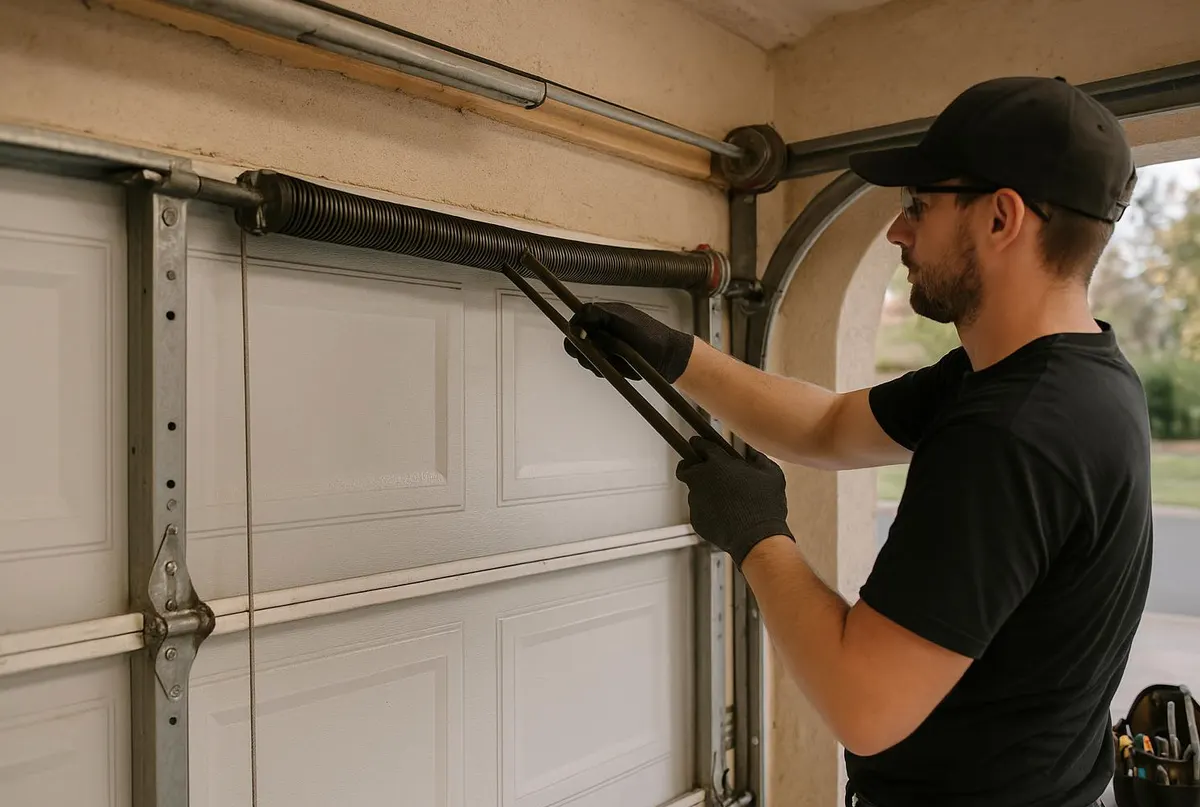
- Check hinges and the torsion spring for surface rust. Light surface rust can often be cleaned and treated with a rust-inhibiting lubricant. Pitted or flaking rust on a spring is a safety concern, not a cosmetic one, since a weakened spring can snap under tension.
- Test the door's balance. Disconnect the opener and lift the door halfway by hand. It should stay put. If it drops or shoots up, something's binding or a spring has lost tension, often from rust or swelling throwing off the alignment.
- Don't just force it through the opener. If the door is dragging and you keep letting the opener muscle it open and closed, you're wearing out the opener motor on top of the door problem.
Repair or Replace: The Honest Trade-Off
Surface rust on hardware and minor swelling that only affects fit, not structure, is usually a repair: clean, treat, lubricate, adjust the track or weatherstrip. Once rust has pitted a spring or hinge, or wood panels have warped enough that they no longer seal or close evenly, replacement of that section is typically more reliable than repair, and safer. Trying to patch a structurally compromised spring to save money is the one shortcut not worth taking.
When to Call Laurel Garage Door Pro
If you're seeing rust on hardware, a door that's noticeably harder to lift than it used to be, or panels that don't close flush anymore, it's worth a proper look before storm season puts more stress on a weakened door. Laurel Garage Door Pro handles Garage Door Tune-Up & Maintenance to catch rust and swelling early, lubricate and adjust hardware, and check spring tension safely. For doors with pitted springs, warped panels, or tracks pulled out of alignment, their Garage Door Panel Replacement and spring repair services get the door back to solid and sealed instead of patched and hoping.
If you're in Laurel, FL or nearby in Sarasota, Venice, Nokomis, Osprey, Englewood, North Port, or Siesta Key and your garage door has been giving you trouble, call Laurel Garage Door Pro before the next round of storms puts it to the test.